
Cross-border deals
Cross-border diligence usually breaks a manual review process in three places at once:
- the evidence is not all in one language
- materiality is spread across multiple currencies
- jurisdiction-sensitive risk gets flattened into generic review
Colabra keeps those dimensions explicit instead of forcing the team to normalize them in spreadsheets and offline trackers.
One room, multiple legal and operating contexts
Real deal example: multilingual customer and holdco structure
A sponsor may be diligencing a German operating company with French customer contracts, a Luxembourg holdco, a Cayman option structure, and USD deal thresholds. The review problem is not just “read the contracts.” It is “make the room comparable, triageable, and routeable across languages, currencies, and jurisdictions.”
Language handling
Colabra stores detected file language as metadata, so multilingual evidence does not disappear into one flat file list.
For readability, document titles are normalised into English or Latin-script titles where needed. That keeps a mixed-language evidence set scannable for the whole team, even when the source files remain in their original language.
For contract review, non-English clauses can be translated into English for consistent diligence analysis while preserving the source text in the evidence. That is useful when the team needs one operating language for review without losing the original wording that the legal conclusion still depends on.
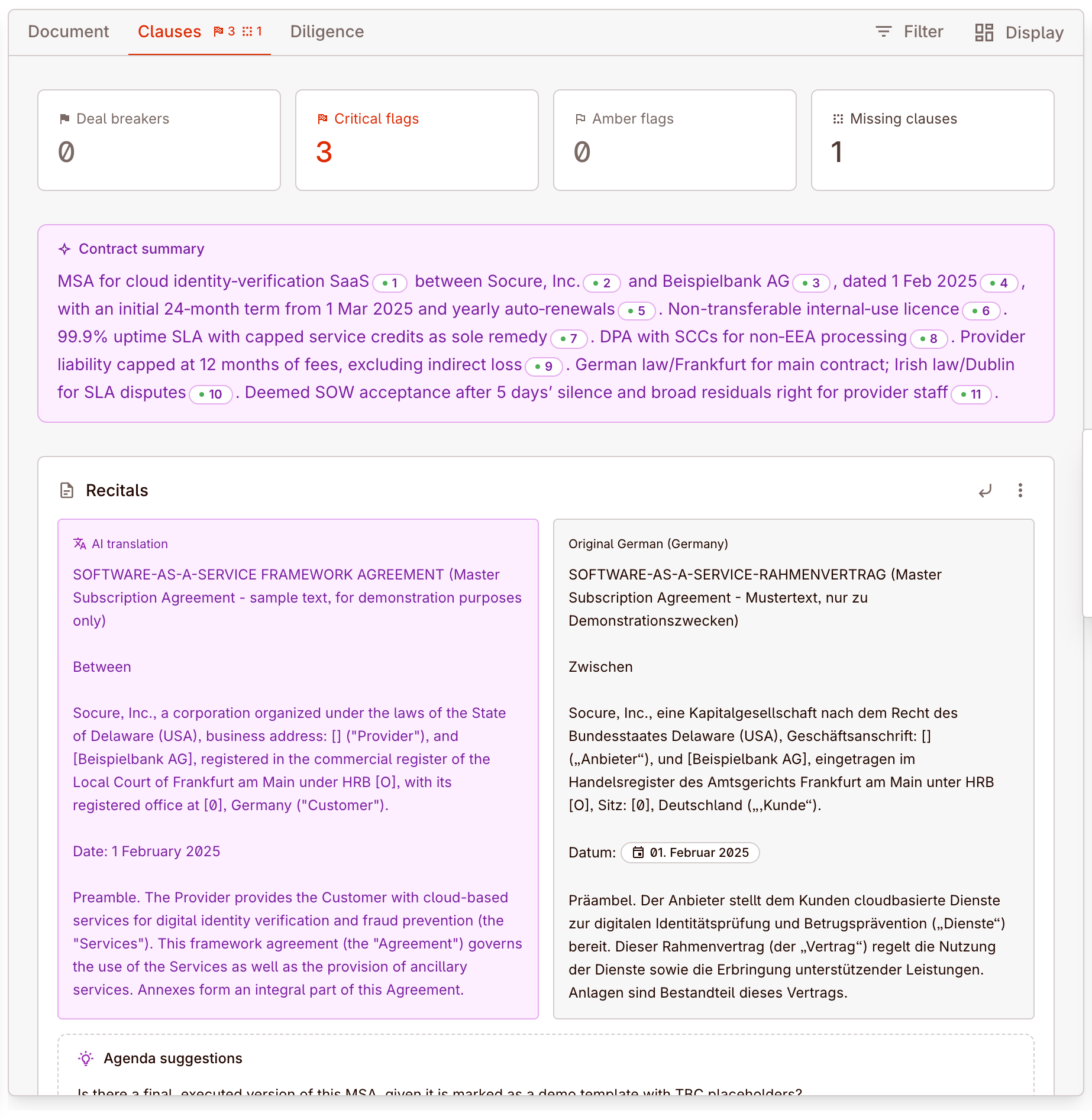
If staffing depends on language expertise, file automation rules can route by detected primary language. That lets a team send German-language contracts to a DACH legal queue, Japanese commercial agreements to the APAC reviewer pool, or French HR material to the right specialist group as soon as processing finishes.
Assignment automation by language
Detected file language and jurisdiction is not just descriptive metadata. It can also drive assignment automation.
If your team staffs cross-border review by language coverage, create a file assignment rule where Language matches the detected primary language, then route matching files to a specific reviewer or a group round robin. For example, you might send Mandarin-language contracts to the China team, German commercial agreements to the DACH queue, or French employment files to the labour specialist group as soon as they are processed.
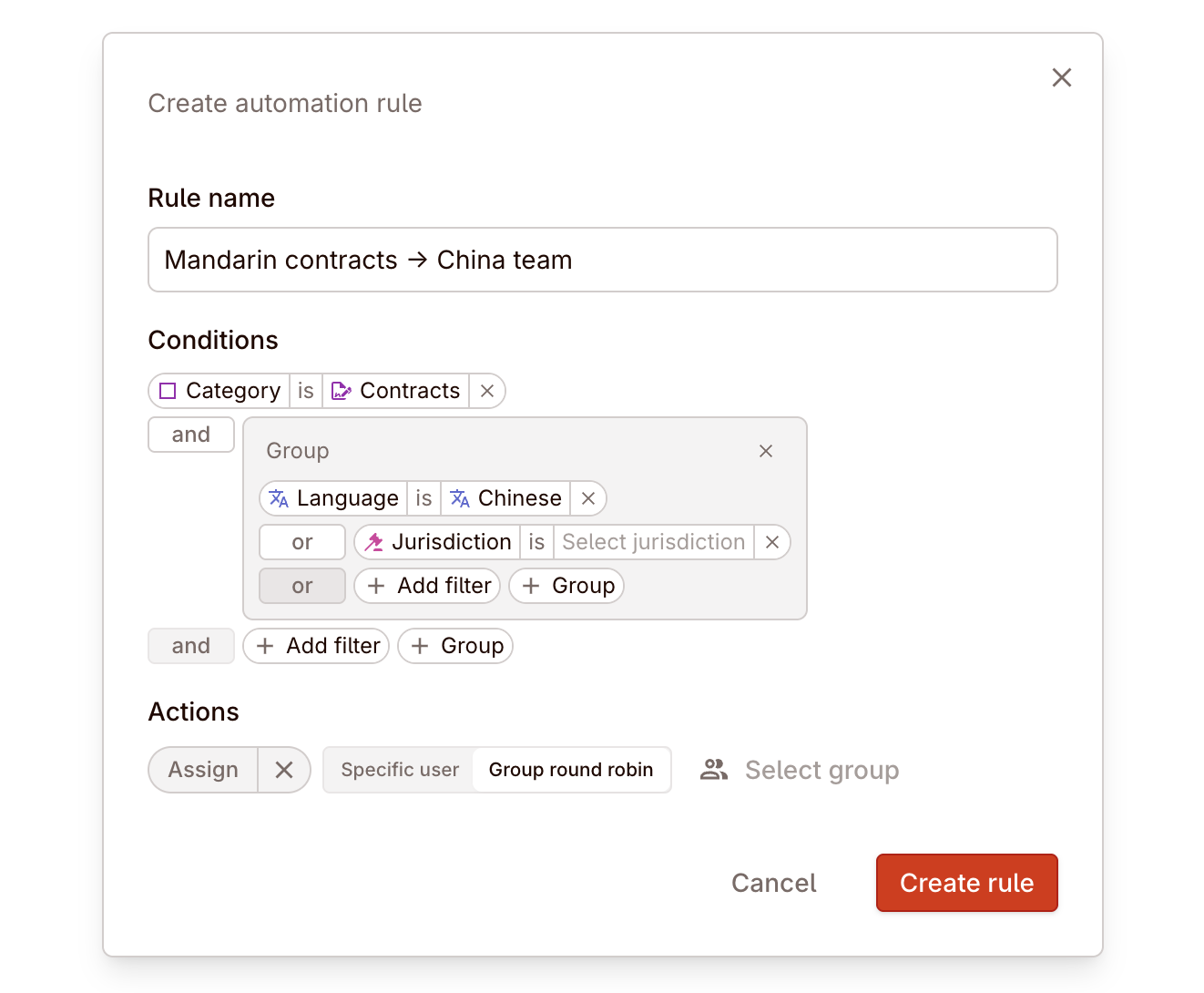
This is the same assignment-automation model described in Automation rules, just applied to multilingual evidence intake. The practical value in a cross-border room is that language routing can happen automatically at file level instead of relying on someone to manually triage every non-English upload.
Currency handling
Cross-border deals also create a comparison problem: the extracted amount may be correct, but the team still needs to know whether it is material for this deal.
Colabra uses a deal base currency in diligence settings. Monetary facts keep their original currency, and the product can also convert them into the base currency for threshold comparisons and review. In the UI, the original amount is preserved and the converted value carries exchange-rate context.
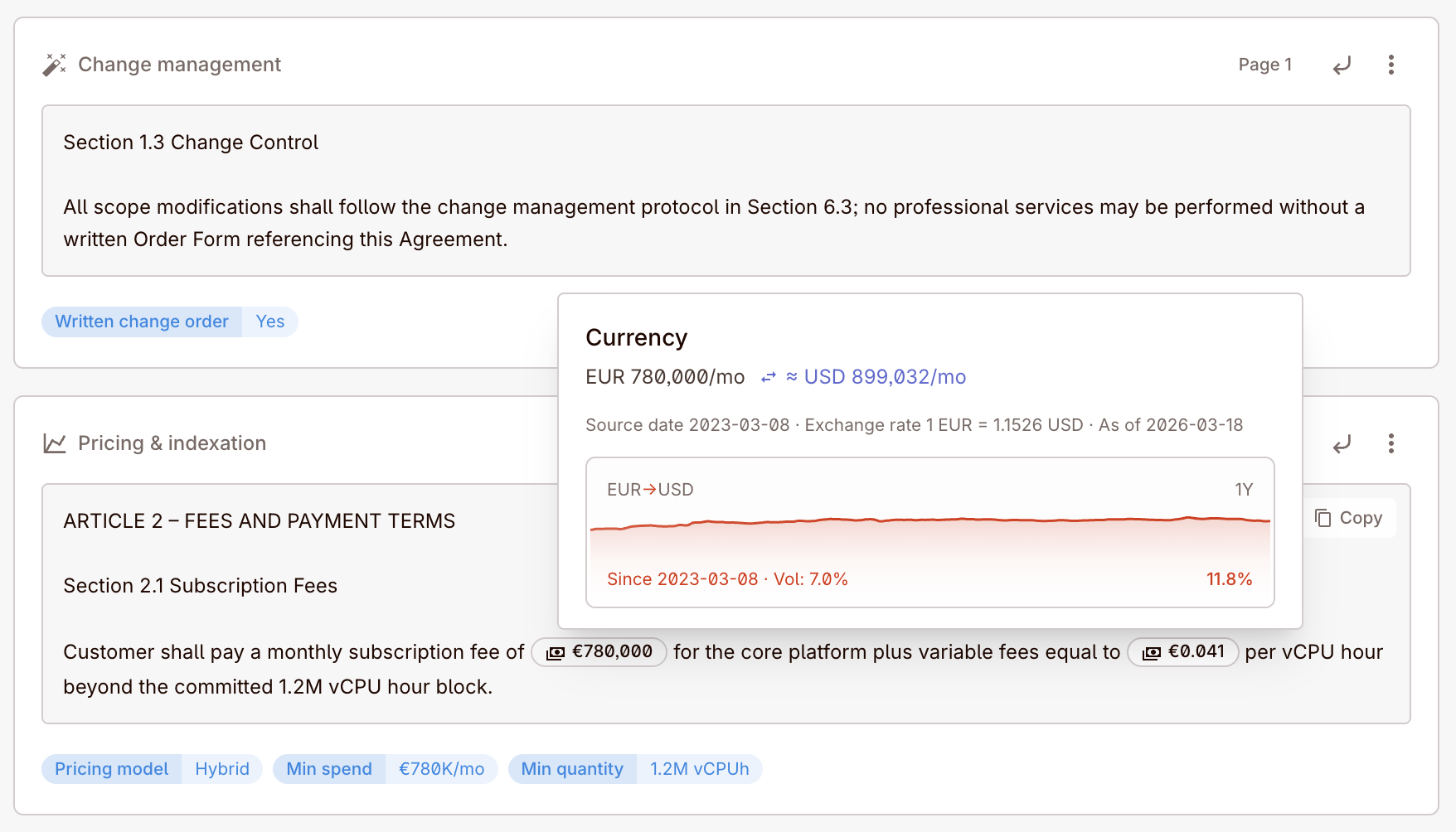
That matters for things like:
- indemnity caps and baskets in contracts
- contract values and revenue concentrations
- litigation amounts
- policy limits and other monetary thresholds
The operating question becomes “is this material against our deal settings?” rather than “who is maintaining the conversion spreadsheet?”
Jurisdiction handling
Colabra extracts governing law and jurisdiction from files, and the diligence-settings layer adds buyer jurisdiction plus high-scrutiny country codes. Those settings shape screening and rule evaluation instead of treating every deal as if it were domestic.
The jurisdiction model is built for M&A practice rather than only country-level tags. The selector supports the full jurisdiction list, with first-class sub-national handling where it is commonly material in deals, including the US, United Kingdom, Canada, Australia, Switzerland, and the UAE. The product also pins the jurisdictions that show up constantly in cross-border structures, such as Delaware, England & Wales, Ontario, Québec, DIFC, ADGM, Cayman, BVI, Jersey, Guernsey, Bermuda, Luxembourg, Ireland, the Netherlands, Germany, France, Singapore, and Hong Kong.
That is what makes cross-border routing and screening usable instead of generic:
- governing law can drive legal review lanes
- jurisdiction can drive specialist assignment
- buyer jurisdiction and high-scrutiny countries can change how sanctions and exposure checks are interpreted
Where this shows up in practice
Cross-border handling is not one feature. It is the combination of several product surfaces working together:
| Surface | What it contributes |
|---|---|
| Extract: Structured data | English-normalised titles, translated contract review surfaces, and structured facts from non-English evidence |
| Diligence settings | Base currency, buyer jurisdiction, and high-scrutiny country defaults |
| Automation rules | Routing by language, governing law, and jurisdiction |
| Screen: Entity risk | Jurisdiction-aware external screening across sanctions, litigation, registry, IP, and license or permit checks |
The point is not to make Colabra a substitute for local counsel. The point is to make a cross-border room operable: readable for the wider team, comparable across currencies, and routable to the right reviewers without rebuilding the process outside the product.